.png)
.png)

.svg)
Stay Empowered with BPE Updates
Join Our Newsletter
Thank you! Your submission has been received!
Oops! Something went wrong while submitting the form.



Login

Login
Sign Up
Welcome back. Log in to continue.
Create your BPE account in a few seconds.
Enter the email associated with your account.
Back to Login
Enter the recovery code we emailed you and choose a new password.
Back to Login
Every second of downtime can cost a data center money, productivity, and customer trust. That makes a reliable UPS system one of the most critical components of modern data center infrastructure. A UPS (Uninterruptible Power Supply) provides immediate backup power during outages and protects critical IT equipment from voltage fluctuations, surges, spikes, and other power disturbances. Whether you operate a small server room, an enterprise data center, or a hyperscale facility, choosing the right UPS system can directly impact uptime, operational efficiency, scalability, and long-term costs. This guide covers the major types of UPS systems, how to choose the right capacity, key features to evaluate, and how intelligent power and thermal management can strengthen overall data center resilience.
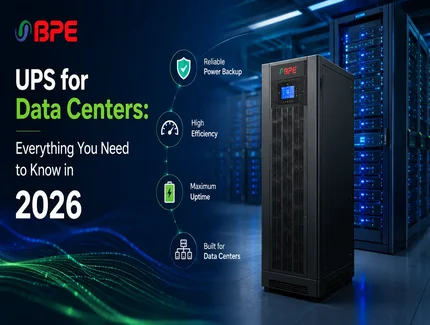
Data centers operate around the clock, supporting applications, databases, financial transactions, cloud platforms, communication networks, and other mission-critical services.
Even a brief power interruption can lead to:
For this reason, UPS systems are not simply backup equipment. They are a fundamental part of a data center's infrastructure.
A data center UPS is a high-capacity, enterprise-grade power protection system designed to keep critical equipment operational when the primary power source fails or becomes unstable.
A UPS typically provides:
Unlike household UPS units, data center UPS systems are built for continuous operation, heavy loads, high availability, scalability, and redundancy.
Depending on the facility, capacities can range from approximately 10 KVA to several megawatts.
Choosing the right UPS topology depends on the size of the facility, criticality of the load, scalability requirements, and redundancy strategy.
An Online Double Conversion UPS continuously supplies connected equipment through the inverter. This isolates sensitive IT equipment from fluctuations and disturbances in the incoming utility supply.
Best suited for:
BPE's Single Phase and Three Phase Online UPS range uses double conversion technology and offers efficiency of up to 99% in eco mode, helping reduce energy consumption and improve overall data center PUE.
Modular UPS systems allow data centers to increase backup power capacity as their infrastructure grows.
Instead of installing one oversized system from the beginning, additional power modules can be added when load requirements increase.
Best suited for:
BPE's Modular UPS systems are designed to support demanding Indian operating conditions, including wide input voltage fluctuations while maintaining stable output for critical infrastructure.
Large data centers often operate substantial three-phase loads, including cooling systems, high-density server racks, and networking infrastructure.
A Three Phase In / Three Phase Out UPS is designed to efficiently support these larger environments.
Best suited for:
Rack Mount UPS systems are designed to fit directly into standard 19-inch server racks.
They can provide localized power protection for individual server clusters, networking equipment, or smaller IT environments.
Best suited for:
Line Interactive UPS systems provide automatic voltage regulation along with battery backup.
They are generally more economical than Online UPS systems but may have a brief transfer time when switching to battery power.
Best suited for:
Correct UPS sizing is essential. An undersized system may not provide adequate protection, while an oversized system can increase investment and operating costs unnecessarily.
A simple sizing approach includes four steps.
Calculate the total power consumption of the equipment you intend to protect, including:
The total load is usually measured in watts or KVA.
Avoid operating the UPS permanently at its maximum rated capacity.
Planning for approximately 60% to 75% utilization can provide additional headroom for future expansion while supporting efficient UPS operation.
Determine how long the UPS must support the connected load.
The required runtime may range from a few minutes, while a generator starts, to 30 minutes or more depending on the site's continuity requirements.
For critical environments, redundancy should be considered during the design stage.
Common configurations include:
These architectures ensure backup capacity remains available even when one UPS unit or module is unavailable due to failure or maintenance.
BPE's technical team provides load assessment and UPS sizing consultations to help organizations select an appropriate power protection configuration for their data center requirements.
Modern data centers require more than battery backup alone.
Power infrastructure must also provide monitoring, predictive insights, control, and integration with broader data center management systems.
BPE's smart power backup ecosystem includes:
A Central Monitoring System allows teams to monitor UPS performance, battery condition, alarms, and load levels from a central dashboard.
A Battery Health Monitoring System helps track battery performance and identify potential issues before they result in failures.
These communication interfaces allow UPS systems to integrate with platforms such as:
A Static Transfer Switch can transfer critical loads between two independent power sources with minimal or no interruption, supporting high-availability environments.
An Automatic Transfer Switch automatically switches power between utility supply and an alternate source such as a generator.
Together, these technologies turn the UPS from a standalone backup device into an intelligent component of the overall data center power architecture.
Best Power Equipment (BPE) provides power protection solutions designed for a wide range of data center environments.
Key strengths include:
BPE systems are designed to operate in environments that may experience:
BPE provides solutions ranging from compact UPS systems to large modular and industrial-scale systems, covering capacities from approximately 1 KVA to 1725 KVA.
Access to service support is essential for mission-critical environments.
BPE offers support for:
BPE products are designed to meet applicable safety, quality, and performance standards.
BPE solutions are used across sectors including:
Beyond UPS equipment, BPE supports customers through consultation, installation, system integration, and after-sales service.
Before selecting a UPS system, evaluate the following factors.
Online Double Conversion UPS systems are generally preferred for highly critical loads, while modular systems offer greater scalability.
Select capacity based on current load requirements while maintaining sufficient headroom for future growth.
Common options include:
Higher UPS efficiency can reduce operating costs and contribute to improved data center PUE.
For large installations, even small efficiency improvements can create meaningful long-term energy savings.
Choose between:
The right option depends on available space, power capacity, and infrastructure design.
Critical facilities should consider N+1 or 2N redundancy depending on uptime and availability requirements.
Features such as SNMP, Modbus, and centralized monitoring platforms improve visibility into UPS health and performance.
Fast service response and reliable after-sales support are especially important in environments where downtime directly impacts operations.
UPS systems protect IT infrastructure from power interruptions. However, power availability alone cannot guarantee uptime.
High-density servers generate substantial heat.
Without effective airflow and cooling management, data centers may experience:
For this reason, power protection and thermal management must work together.
BPE addresses these requirements through solutions such as the Air Balancing System and Active Tiles, designed to complement data center UPS infrastructure.
Room-level temperature readings do not always reveal what is happening inside individual server racks.
Common rack-level cooling problems include:
These issues can affect performance even when the overall data center temperature appears normal.
The BPE Air Balancing System is designed to improve airflow distribution within individual server racks.
Its tray-clamp mounting approach allows it to work across different rack widths without requiring major structural modifications.
The system continuously manages airflow to reduce hot spots and maintain more consistent rack temperatures.
Integrated sensors monitor temperature and humidity continuously, with readings displayed through the onboard interface.
Fan speed and air velocity can be adjusted based on real-time thermal conditions.
Airflow can also be directed through adjustable operating angles.
Louvers and baffles help redirect exhaust air away from server intake areas, reducing hot and cold air mixing.
Better airflow distribution helps maintain a more uniform temperature across different rack levels and devices.
Additional capabilities include:
These features allow thermal management to work alongside the wider UPS and monitoring ecosystem.
Raised-floor data centers can suffer from uneven cold-air delivery, particularly around high-density racks.
Traditional perforated floor tiles may not always deliver sufficient airflow where it is needed most.
BPE Active Tiles are designed to provide more targeted cooling through integrated fans, sensors, and airflow controls.
The solution also includes approximately 30 minutes of battery backup through an integrated UPS, helping maintain airflow during short power transitions.
The compact design reduces the amount of under-floor plenum space required compared with larger conventional active tile systems.
The reinforced plastic structure is designed to be:
Active Tiles can be configured with four or eight fans, depending on airflow requirements.
Hot-swappable modules and failure alarms support higher availability.
The system supports both UPS AC power and SMPS DC configurations.
Brushless DC fans operate at approximately 48 dBA, supporting high-density cooling while limiting acoustic impact.
The system is designed to reduce energy consumption and operating costs while also offering easier logistics because of its lightweight construction.
Active Tiles can replace standard raised-floor tiles without requiring major structural modifications.
Individual fan speed control allows airflow to be adjusted according to the cooling needs of each rack.
This gives data center operators more precise control over cold-air delivery while maintaining cooling during short power interruptions.
Data center resilience depends on more than simply preventing a power outage.
Power systems must keep infrastructure operational, while cooling systems must ensure that equipment continues operating safely and efficiently.
By combining:
BPE provides an integrated approach to power protection and thermal management.
The result is a more resilient infrastructure designed to support:
Choosing the right UPS system can directly influence your data center's uptime, operational efficiency, equipment reliability, and long-term costs.
A small server room may require a compact rack-mounted UPS, while enterprise or Tier 4 facilities may need scalable modular systems with advanced redundancy and monitoring.
But true data center resilience goes beyond backup power.
Combining reliable UPS infrastructure with intelligent monitoring and effective thermal management creates a stronger foundation for continuous operation.
BPE brings together UPS systems, smart monitoring technologies, rack-level airflow management, Active Tiles, and nationwide service support to help organizations build reliable and efficient data center infrastructure.
Looking for the right power protection solution for your data center?
Contact BPE for a site assessment and customized UPS solution based on your infrastructure, load, and uptime requirements.
Online double conversion UPS is considered the best for data centers because it provides zero transfer time and completely isolates the load from raw utility power. For large or growing facilities, modular UPS systems are preferred for their scalability and built-in redundancy.
Add the total power consumption in KVA or watts of all equipment you need to protect. Then size your UPS so the connected load does not exceed 70–75% of the UPS capacity. Factor in runtime requirements and future growth to finalize the right size.
A modular UPS allows you to add power capacity incrementally as your data center grows, with hot-swappable modules and N+1 redundancy built in. A traditional monolithic UPS is a single fixed-capacity unit. Modular systems offer better scalability, easier maintenance, and lower total cost of ownership for dynamic data center environments.
Standard data center UPS systems are typically designed for 5 to 15 minutes of runtime, just long enough for generators to start or for a graceful shutdown. Extended runtime batteries or additional battery cabinets can increase this to 30 minutes or more depending on load.
Yes. Best Power Equipment (BPE) provides end-to-end services including UPS installation, commissioning, Annual Maintenance Contracts (AMC), battery replacement, and 24/7 remote monitoring support for data center clients across India.
Join Our Newsletter